From Poetry Parnassus straight into the London Literature Festival! My shifts this week were a little hectic at the Southbank Centre, especially yesterday when a school visit coincided with the Shake the Dust finals (a national youth poetry slam competition). I've been to two events this week, a talk by Michael Morpurgo and his biographer Maggie Fergusson, and 100% Proof, a Shake the Dust event which showcased the works of the Shake the Dust regional poet coaches, a slam/drama group from the US called First Wave, and Lemn Sissay, who is a Southbank associate poet and the first poet commissioned to write for the London Olympics. It's been a good week, and it's been lovely to share it with my sister and dad, who accompanied me to these events, and a couple of friends and aquaintances who just happened to be there!
The Michael Morpurgo event was absolutely lovely. He is one of my sister's favourite writers and I enjoyed his books when I was younger. I remember seeing a production of 'Kensuke's Kingdom' at the Polka Theatre in Wimbledon when I was little, and it became one of my favourite books as a child. It was wonderful to see such an audience at this event - children and their families who are currently reading Morpurgo's books, young adults like myself who remember how special his stories were from our childhoods, and teachers, parents and grandparents who have enjoyed reading the stories to their children over the years. It was amazing just how many different age groups Morpurgo has touched with his writing. Also as special was the way that Morpurgo spoke to the audience. The memories revealed in the talk - for example, the separation of his parents - were not entirely comfortable, and yet Morpurgo manages to speak in such a way that does not dumb down the facts for children, but that retains a greater simplicity and honesty than the way adults interact with one another and censor themselves and each other.
The talk opened the London Literature Festival and promotes 'Michael Morpurgo: War Child to War Horse', a biography by Maggie Fergusson which takes the interesting form of seven chapters - the seven stages of life - to which Morpurgo has responded with seven new stories. It's a collaborative effort, with Fergusson chronicling and Morpurgo reflecting, and I can't wait to read it. The talk itself was about how the book was made, the memories and experiences it stirred up for Morpurgo, and a reading of one of the stories from the book, followed by questions and answers and even Michael singing a song from the stage production of War Horse!
It was a very special talk and a priviledge to be there and to share it with my sister.
100% Proof was very different but equally enjoyable. It began with readings from the regional poet coaches: Molly Naylor, Michelle Hubbard, Kat Francois, Alfie Crow, Frisko, Michael Parker, Sarah Jane Arbury, Brenda Read-Brown, and Si Murray. I enjoyed most of these, and it was wonderful to see such a spectrum of styles, from gritty hip-hop to lyrical storytelling, playful punning and even some singing. I particulary enjoyed Michelle Hubbard, Sarah Jane Arbury and Brenda Read-Brown. Again, these poets had dramatically different styles but were equally touching and enjoyable in their performances. Next up was First Wave, who performed a 30 minute extract of their touring poetry/drama production. I was impressed by the quality of their act, which addressed racism, discrimination, and being an outsider in challenging terms. Their act was not something I would think to go and see normally, and I felt alienated after a bit (although this in itself made me realise just how lucky I am that the people I know in London are so accepting of each other and of me, on all grounds - race, gender, age), but they did a fantastic job and put on a really thought-provoking show. The final act was Lemn Sissay, and it was clear as soon as he came on stage and launched straight into a poem, that here was a master at work. While the other acts of the night had all been good, both Sissay's poetry and performance were on another level. His delivery was wonderfully energetic, his poems both celebratory and thought-provoking. That, and he just seemed like a really cool guy, involved the audience, and is clearly a born performer. It was a wonderful night!
My experience of Poetry Parnassus and the London Literature Festival (as well as other events I have been to in the past) have really changed the way I think about poetry, performance, and the way I want my own work to take me. I started writing when I was inspired by artists like Zena Edwards and Dizraeli, and wanted really to be a performance poet. Recently however, I've realised just how much more suited to the medium of paper I am; that doesn't mean that I can't, and don't enjoy, reading my poems to an audience - I absolutely love it! It's just that I've realised that for me, the poetry comes first, the performance second. The first tenet of slam and performance poetry is that the poetry should come first, but too many times have I sat in front of a confident performer reading at best mediocre poetry. Luckily I haven't had to sit through something like that for quite a while now, and those performers whom I've seen recently have really impressed me, but I think the danger with writing for performance is that the poetry suffers. Yes, supposedly it's all about the poetry, but this isn't true, is it? Quite often performance poetry appears as just a big ego trip, with poets thinking more about their own kudos than about the poetry. I recently watched one performance when the poet actually said, "usually I write about boys, but this poem is about me!" and to me this is the trap that many aspiring poets fall into. Yes, it's fun to read your poems out loud, and get to act them a bit; yes, it's really cool when an audience responds well to your work; yes, it's important to share and preserve our oral traditions; yes, it's wonderful that performance poetry blurs the line so much with hiphop, music and acting. But it is still supposed to be POETRY. Poetry Parnassus and 100% Proof show that it is still possible to put poetry first, and I hope that we can all learn from the example of these poets.
Showing posts with label contemporary. Show all posts
Showing posts with label contemporary. Show all posts
Saturday, July 7, 2012

Friday, April 6, 2012
'Why Be Happy When You Could Be Normal' by Jeanette Winterson
I saw Jeanette Winterson give a talk at UEA in March, in which she read from this, her new book. Just like I had snapped up a ticket to go and see her speak, I snapped up this book. Both the talk and the book are for me two pieces of that rare art that absolutely touches you. Seeing her speak, and hearing her recite a couple of lines of T. S. Eliot, almost had me in tears. Winterson is just one of those writers who can cut to the heart of things, and show them in all their beauty and sadness. Read her books.
Why Be Happy..? revisits Winterson's experience of growing up that she first wrote about in the wonderful Oranges Are Not The Only Fruit. Once again, Winterson tackles painful issues such as adoption, religious dogma and growing up with sharp, tender, inspiring humour. It's witty, it's poignant. It traces her childhood and teenage years, escape from working class Accrington to Oxford, mental breakdown, and trying to trace her biological mother. It covers a lot of ground, some of it already trodden, but all of it original, exciting, touching, funny.
I'll be passing this book around to my nearest and dearest. It's not just an autobiography. It is so many things besides. You'll have to read it yourself to find out. The one thing I found slightly wearing was that the 'grown up' bit of the book seemed slightly self-indulgent to me...but then again, Winterson is undoubtedly a writer who deserves to indulge herself.
A great book.
Saturday, December 24, 2011
Catch-up and Pig by Andrew Cowan
The irony is, I've just finished my first semester of my degree in Eng Lit at UEA, and have been reading all sorts, but haven't found the time to write about any of the texts I've come across. Apologies for such a long lonely desolate gap in blogging, but rest assured I will try and be a bit less useless from now on!
I've been writing lots - had a gap where I didn't seem to be able to write at all, and then when I finally did start writing it all came out as self-indulgent crap. Although there have been some good things I've written...lots of lyrics, for example, and an epic prose poem, and I started writing some short stories and a play script...poetry is still the only thing I seem able to finish off to any degree of finished-ness, but I'm beginning to dip my toes in other things, we shall see where it takes me...
Possibly the biggest change since I last blogged is that my whole life has been turned upside-down, my horizons have been broadened, my world view rounded, my personal development developed, my heart and soul have been made exultant, my intellect has been astounded etc. etc. by my new love for the Romantics. Primary school murdered Wordsworth for me cruelly and in cold blood many years ago, but I have rediscovered him through The Prelude. In terms of studying it, it's a pain in the arse because every sentence is about 2385082370875023 lines long and by the time you get to a full stop you can't remember what on earth he was talking about at the beginning. But even so, I loved it. And Percy Bysshe Shelley! What a babe! What a legend! Me and Shelley, we got a thang going on. I love that dude. The epicnosity of ol' Percy B. cannot be described. Basically he's just a well cool dude.
What I love about the Romantics is how kick-arse they were. They were absolutely radical, and I hadn't appreciated that before. Also, Wordsworth was a bit of a babe for being in France during the Revolution. And they still interest me despite the fact that most of them became beige beaurocratic Tories in later life (although Shelley - what an awesome dude he was! - wrote an Elegy for Wordsworth when Ol' Bill was still alive to bemoan his loss of principles and abandonment of his duty to the Great Goddess Poesia). Who would've thought it? Me absolutely besotted by the Romantics?!
Anyway, aside from Ol' Bill and a bit of Percy Bysshe I've had John Gower, Chaucer, Hildegard of Bingen, George Gissing, Yeats, Deborah Eisenberg, Caryl Churchill, Samuel Beckett, Derek Mahon and so many more, thrust at me with instructions to devour them and come back with some ideas. Loving every second of it. I shall review Deborah Eisenberg at a later date for sure, as I AM ACTUALLY HEAD OVER HEELS IN LOVE WITH HER WRITING.
Anyway, I also skimmed Eugene Ionesco's 'Rhinoceros' for a French Module (in the original French). Very interesting play. I think I'd like to see it on the stage though; it was some what depressing rushing it within the last two days I had to write an essay on it. And also, again for a French module, I have been organising a bilingual poetry slam event. Despite the unhelpful interfering of a particularly negative tutor who twisted our arms and made us cancel our first planned event, it is back on for January now. Fingers crossed all goes to plan. It probably won't. But at least it was a good idea in the first place, it had potential to be amazing, and I can now turn to the uplifting and sustaining works of the Romantics to cheer myself up if it turns out to be a complete flop. But yeah, anyway, if anybody reading this happens to be in Norwich on January 24th, head down to the Workshop on Earlham Road. There will be food, there will be booze (you have to pay, we're students, we can't afford it, sorry) and there will be poetry. So come on down and help make it a success, so that I don't have to seek comfort in the papery posthumous arms of Percy. Please.
Anyway, onto Andrew Cowan's 'Pig' which I have just read in preparation for next semester's so-called hard work. 'Pig' tells the story of Danny, who lives on the outskirts of an industrial town that has suffered with the closing of its steel works. His grandparents live in a cottage, where they grow their own food and keep a pig. When Danny's gran dies, and his Grandad is removed to a home, he takes on caring for the pig and looking after the house. He and his Indian girlfriend Surinder use it as a meeting place. Their relationship is secret and set against a backdrop of racist tension. As the summer progresses, this tension begins to rise and Danny and Surinder's hiding place is in jeopardy from the encroaching of a theme park to be built behind the cottage.
I enjoyed 'Pig'. What struck me about Cowan's writing was the attention to detail. The appearance, smells, textures of settings in particular was highly evocative and very skillfully crafted. The characters were believable, and the voice of Danny was convincing (although I felt he was maybe portrayed as a little younger than he was supposed to be). I think the novel stands on the intense detail that Cowan manages to convey. What would otherwise be a fairly ordinary novel about fairly ordinary people in fairly ordinary situations becomes a page-turner through the quality of the writing. That said, I was glad to finish the book, and to be able to move on. It felt like a holiday read, a book to ease me into something I could really get my literature-hungry teeth into (now halfway through Mrs Dalloway, and loving it). So yeah, it was a nice book, a pretty good book, but not one I'd go back to (unless I had to study it...oh, wait!) and not one that made my imagination do dizzying loop-de-loops or scale great heights of intellectual magnificence...
Anyway, that is it for now. I see that I have two new followers. Welcome, and thank you! I'm on the old Twit-twoo if you're interested, it's @FloMoses.
Anyway, obrigada for your patience and ate ja :)
Tuesday, August 30, 2011
Resistance by Owen Sheers
I read this as I have enjoyed some of Sheers' work in the past, and as he was doing a book signing at the shop where I worked over the summer I thought I'd better read it.
Resistance quickly became my crappy holiday read. It was mildly interesting and didn't require any deep thought to get through it. I didn't enjoy it hugely, but equally I felt like I should finish it.
It tells the story of Sarah Lewis and her neighbours in an isolated Welsh valley during an imagined Nazi invasion of Britain during the Second World War. An German patrol comes to the valley for mysterious reasons, and ends up staying there. Meanwhile, the husbands of the women of the valley have gone missing, leaving in the night soon after the first wave of invasion. Whilst worrying about their husbands, Sarah and her neighbours must swallow the unsavoury fact that if they want to keep their farms running during their husbands' absence, they will need to bury the hatchet when it comes to dealing with the occupying patrol.
I think the reason this book didn't really click with me was that such a large proportion of it describes the women's rural labours and the landscape - this is not a book of action. Also, the human relationships on which the whole plot hinges didn't ring true. The old creative-writing adage of 'show not tell' may be cliched but I felt as if Sheers would have done better in applying it more meticulously. Instead of letting the plot, character formation and dialogue speak for themselves, at times I felt as if I were being lectured; it felt a bit contrived and 'try-hard' at times. For me, it certainly lacked the spark of Sheers' poetry.
However, the film of Resistance is soon to be released, and despite it being my crappy holiday read, I can't deny that Sheers has achieved the dream of many people - his first novel has been turned into a film, and he will quite possibly make megabucks, despite the fact to me Resistance was disapointingly lack-lustre.
Wednesday, August 10, 2011
Birds Without Wings by Louis de Bernieres
Just finished this 600-odd page book this evening, after perhaps two weeks since I first started reading it.
Birds Without Wings tells the various entertwining stories of the people of a small Anatolian town called Eskibahce in the Ottoman Empire, in the years preceding and following WWI and the Turkish War of Independence. In Eskibahce, as all over the empire, people of different religions and ethnic groups live side by side and mostly peacefully, uited by the Turkish language, and with friendships and intermarriage making these different groups inseparable in places. Each chapter reads almost like short story, detailing key events in the lives of the people of Eskibahce, including the games of the towns children, the unlikely friendship between the Orthodox Greek priest and the town's Imam, and more sinister events such as an attempted stoning and the exhumation of a corpse.
Alongside this, the tale of Mustafa Kemal, aka Ataturk, is interwoven, as the people of Eskibahce find themselves caught up in a world where the distinction between Turkish and Greek becomes seemingly more important and leads to all sorts of trouble. The story is told through multiple voices, including an omniscient 3rd person, and through several of the characters, both as they live the events of the book, and as they look back on them in later life.
I really loved this book. de Bernieres presents colourful, flawed but likeable characters, and I found the stories of life in Eskibahce charming and moving. I was gripped by the sense of inevitability brought in through the reflective passages and the inclusion of Mustafa Kemal Ataturk's rise to power, and really wanted to find out what would happen to the characters.
The charming and often humourous exploits of Eskibahce were eventually replaced by sensitive but honest and horrific details of the events of the decade of war that the people of the Ottoman Empire faced in the early twentieth century. Some of the stuff included - in just enough detail to be shocking without being too horrible to read - was unimagineably awful, and opened my eyes to a side of fairly recent history that I had no idea about before reading this book.
I found that towards the end of the book the narrative of Ataturk's rise to power took over a bit. This was necessary to explain what would eventually happen to the Eskibahce characters, although I felt that it dominated a little bit too much and that, despite Bernieres' drawing in of the novel's characters in places, this section of the book could have done with a more human element, to bring it down to a human level and to make it a little less dry. I started to wish that I could read something else at this point, although the end of the book was worth the wait and I couldn't put it down until I had devoured every word.
An important aspect of the book that I haven't yet mentioned is de Bernieres' writing itself. I have never read him before but it strikes me that he writes extremely well. Characters are excellently drawn, humour and poignancy are both handled deftly and sensitively, and his choice of language is an absolute lexical feast. Despite using such rarified words as 'mommixity', 'foofaraw', and 'dunderpate', de Bernieres' prose remains highly readable, and even when I didn't know the exact dictionary definition of a particular word (particularly some Turkish terms), the language is handled so beautifully that the meaning is still clear and the words delicious. de Bernieres uses them sparingly, always using the perfect word for the occasion, whilst visibly revelling in such nuances of language. Beautifully written.
A really fantastic read. de Bernieres writes fantastically well and in Birds Without Wings has created a moving story about the highs and lows of being human in the face of adversity. A great book.
Wednesday, August 3, 2011
More Ruth Padel and some Louis de Bernieres
Read another two collections by Ruth Padel recently - Rembrandt Would Have Loved You and Fusewire. Rembrant was a lovely read. It was obviously an earlier collection and Padel's sensual style was a bit less developed but I still absolutely loved it, the love poems and use of the kind of scene you see in paintings by the Dutch Masters as an image was absolutely lovely. Fusewire is even earlier, and very politically-focused, particularly on conflict between Britain and Ireland. For this reason I didn't identify with it so much - I'm young enough that I haven't even been taught about the Troubles in school, let alone remember them - although I loved one poem in particular, 'Desire Paths of Sarajevo', which juxtaposes scenes of genocide and suffering with the comfort of love and the tenderness/violence of sex.
I recently bought Pascale Petit's 'The Treekeeper's Tale' and Carol Rumens' 'De Chirico's Threads' (I love De Chirico, the half-cartoon, half-sci-fi, surrealist style of his and the beautiful scenes of Hector and Andromache) and even though I am dying to tear into them I am holding off so that I finish Louis de Bernieres' Birds Without Wings, which I am absolutely adoring (any book that is compellingly readable but still contains the words 'mommixity' and 'foofaraw' is OK by me). L'Etranger is lying in a corner gathering dust. I am trying to forget to feel guilty about this.
Tuesday, July 26, 2011
Voodoo Shop by Ruth Padel
I am a big fan of Ruth Padel and after reading 'The Soho Leopard' bought many of her earlier collections. Voodoo Shop is from 2002.
Wow. Where to begin? This collection follows the stages of a love affair, the lovers travelling the world and their relationship explored through the different locations and experiences that they share, from buying twin voodoo dolls in South America, to watching flocks of seabirds in Ireland. Along the way bereavement, sex, love, infidelity/illicit affairs and the breakdown of a relationship are explored with Padel's trademark style: painterly, exotic and lyrical with human experience linked inextricably with the natural world. This collection is an eclectic mix of imagery, emotion and language, and is completely different to what I expected. I absolutely loved it.
Favourite poems? There are so many killer lines throughout the collection, and while eclectic it holds together so well, that it is difficult to choose individual poems, but I would have to say 'Hey Sugar, Take A Walk On The Wild Side', where the lovers are compared exquisitely to olive oil; 'Rattlesnakes And Rubies' for the colours and the humour; and the final poem, 'Casablanca and the Children of Storm' for its true-to-life emotions and magical descriptions of seabirds.
Padel's writing in Voodoo Shop is wonderful; it's sometimes verging on obscure but always beautiful, and very original. I get the feeling that she is a poet who really appreciates the music of words and images. Even when writing about sadness or even crudeness, she manages to bring a lightness of touch and beauty to difficult subjects.
This collection really touched me and I'm sure it will remain one of my favourites. I couldn't put it down when I was reading it - I raced from poem to poem, and will enjoy going back to it over the years to savour it again.
Tuesday, July 19, 2011
The Reluctant Fundamentalist by Mohsin Hamid
Finished this a couple of days ago, having started it ages ago, let it drop to the bottom of the pile and then finished it off. Thought it sounded interesting: literature with a certain sense of the 'exotic' always appeals to me and it was shortlisted for the Booker or something.
How can I describe this book? It takes the form of a conversation between the narrator Changez and a silent American who he meets in downtown Lahore, Pakistan. We only read Changez's contribution to the conversation as he invites his new aquaintance to dine with him whilst telling his story. Turns out that Changez is a Princeton graduate who lived and loved in America for several years. His reminiscences of his time in America are interwoven with one-sided exchanges with the silent American and evocative, painterly descriptions of the Lahore district they are dining in. The story of Changez is no great adventure but presents a compelling view of what it is like to be an outsider, in both your home country and foreign places, and offers a perspective on such events as 9/11 that we don't often get to hear about in the West.
The form of the novel as half of a conversation between two people made it very readable and easy to get into. I wouldn't say that the style was amazing or even literary - I was surprised that this was nominated for the Booker; to me it was more like an easy holiday read - but it was accessible and kept me reading. I found the characterisation to be well-constructed. Changez's voice is believable, with the flaws, confusion and inconsistency of a real human being. I found the perspective and underlying message of the book thought-provoking and interesting, although the ending was a bit disappointing. For me it was just a little too open to be satisfying, particularly when seen in the context of the hints dropped throughout the book.
In short, I enjoyed it, it made me think, and it was a quick and easy read. But not amazing. Something I'd buy at an airport, read on holiday, and to be honest it'sbeen a couple of days since I finished it and I'm already forgetting it. 5/10.
Latitude 2011 & Good News!!
First the really cool news, today I signed up for abctales.com, where you can share your stories and poems online, and I uploaded two poems (unseen on this blog). Just found out that they have been cherrypicked by the editors and have had a warm reception from fellow abctales-ers! The poems are 'Plastic Lovespoon' and 'Blind Woman at Clapham Junction' and can be read here. Please take a look!
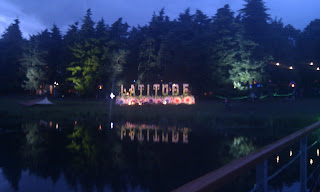
Latitude is a music festival with a difference, also featuring comedy, theatre and literature among much much more. I just got back from this year's festival and thought I'd write about the amazing wordsmithing I found there.
I spent a lot of time in the poetry tent and the poets that I saw read/perform include:
- Sophie Hannah
- Jo Shapcott
- Dizraeli and the Small Gods
- Amy Blakemore
- Hannah Jane Walker
- Kate Fox News
- Jack Dean
- Mab Jones
- Sam Riviere
Who shone? Dizraeli and the Small Gods - a beautiful, emotional mix of music, rap and poetry; Mab Jones - comic, honest poetry about life's minutiae, really loved it; Hannah Jane Walker for thought-provoking, lyrical poems; and Amy Blakemore for a young voice with surprising maturity and real originality. I urge you to check these guys out online, they were fantastic, and I am going to try and persuade a bookshop that I know in Wales to book a reading with Mab Jones!
Who disappointed me? Well, no one really, all the acts I saw were of a really high quality. However, Sophie Hannah's reading was more like a rant and although humourous at times I also left wondering if she was a psychopath..... Sam Riviere's work seemed, from what I caught of it, to be about the issues of identity and being an outsider, including a long poem about a trip to America. Interesting but not my personal cup of tea. Jo Shapcott read a series of poems about bees, and at that point I had to leave. But I was disappointed with her reading - it lacked audience connection, I felt, and although I love her poetry, the beekeeper in me (yes, I do actually keep bees, have done for 6 years now I think) was frustrated with her overly simplistic explanations to the audience about the science behind the poetry, the science of bees, and her mis-pronunciation of the word 'propolis'. But that's just me being nit-pickety.
What really fascinated me however was the different reading/performing styles of the poets. Some read from books or pieces of paper, e.g. Amy Blakemore, Sophie Hannah, Jo Shapcott - whereas others recited their work from memory, e.g. Mab Jones, Dizraeli, Jack Dean. Both methods worked well but undoubtedly those who had memorised their poems gave more energetic performances. So I picked up some interesting tips for when I am brave enough to finally enter an open mic! Who knows, maybe at next year's Latitude...?
Anyway, just a few musings on the world of the live spoken-word performance. For those who are into performance poetry like me, I can highly recommend Latitude festival; the poetry line-up was wide-reaching, varied and inspiring.
Thursday, June 23, 2011
77 Love Sonnets by Garrison Keillor
I got this beautiful little book as a gift. It comes with 2 CDs of Garrison reading and singing the sonnets, which I loved. I am a big fan of his, I love the Lake Woebegon stories - I have never read them, only listened to them on tape. So the fact that I could read and listen to these sonnets was lovely.
After reading the first two sonnets my reaction was "wow! these are really good!" and this reaction continued to the end of the collection. Not to say that there aren't some weaker ones, but I was struck by how cleverly Keillor uses the sonnet form. I loved the references to earlier sonnets, for example in 'My Love' which references Bunyan, Herrick, Marlowe...but the real strength of this collection is Keillor's observations of ordinary humanness and exquisitely playful matching of language and form.
I loved this little book. Lots of it's about love, lots about sex, lots about growing old, and lots about ordinary people, and lots of other themes to boot. Beautifully written sonnets with Keillor's own brand of tender humour. Loved it.
Tuesday, April 26, 2011
The Thing in the Gap-Stone Stile, by Alice Oswald
Alice Oswald: successful British poet. Her most recent collection is 'A Sleepwalk on the Severn', I think published earlier this year or late 2010. Gap-Stone Stile was her first collection, from years ago. I know she's a well-respected poet but this was the first of her work I have read.
I quite enjoyed it actually. Some of the stuff just didn't do it for me - some of the Sea Sonnets, for example, to my poetic ear just didn't 'sing', and there were aspects of certain poems that irritated me a little - some just didn't ring true, sounded a bit pretentious. But in all I really liked the collection and I can understand why Oswald is as well-respected as she is. I'm sure her later collections are much more fully-formed.
My favourite poems were The Melon Grower, about a man who neglects his family as he cares for his melon plants (I have grown melons myself, and became quite attached to them, so I could sympathise with his predicament!), one about owls in which there was the lovely line 'an owl about the size of a vicar' - loved it. That line really stood out for me, the incongruity of its humour in a poem with a more serious tone - and a couple of poems addressed to the only-just tolerated nextdoor neighbour. For me it was the flashes of humour in the collection, and the human stories that shone, rather than the soliloquising about water and gardens and nature, which is what Oswald is particularly known for. No - those weren't bad, but they didn't move me. Personally, I feel that a nature poem has to absolutely convey a sense of sheer wonder, and the ones in this collection didn't communicate that to me. However, Oswald's softly-spoken but sharp observations of humanity were brilliant.
At the end of the collection is a long poem about three men from the village of Gotham who go to try and catch the moon in a net (and its title is similarly self-explanatory). Strange. Some of the language was interesting, but it didn't speak to me. The poet's message or whatever it was she wanted to communicate went over my head. It seemed to be long and pretentious for the sake of being long and pretentious, and mostly lacked Oswald's otherwise frequent and clever use of half-rhyme. Didn't get it, although I found the explanation of the ideas behind the poem very entertaining and interesting, and intend to research Gotham - and its strange antic disposition - a little further.
In all, an interesting collection, but one that I sometimes found too serious, and occasionally a little obscure and pretentious. However, there were some lovely lyrical lines and the flashes of human lives and humour were a joy to read. I will read this collection again at some point, and I definitely want to read some of Alice Oswald's later works. A 5 or 6 out of 10 for me, but an intriguing and encouraging one.
Monday, March 7, 2011
Never Let Me Go by Kazuo Ishiguro
Yeah yeah, I know I've only read this because it's recently been turned into a film, but I haven't seen the film yet, so it's alright! Also I've read some of his Nocturnes before and have always been tempted by An Artist of the Floating World. But this is the first full Ishiguro I have read, and hopefully I'm off to see the film this week, so it will be interesting to compare.
But anyway, the book. I really enjoyed it. Short and sweet, literaray but not head-in-the-clouds, difficult message but easy reading. I think everyone should read this book, even if they don't usually enjoy reading. It was such a relief from the old D. H. Lawrence (I'm still struggling through that...I loved it but he's really over-descriptive!) but was still sophisticated and interesting.
Brief outline: Kathy, Tommy and Ruth are students at Hailsham. Eventually they go out into the big wide world. Their world is not like ours: after the Second World War, it was discovered that all sorts of diseases could be cured through transplants, and so they started manufacturing clones to grow organs. The book tells the story of their complex relationships, the clone + transplants thing being mostly a distant - but crucial - backdrop.
When I was enthusing about this book to one of my friends, she screwed up her face and said, "sounds just like 'The Island'." Referring of course to that mediocre Ewan McGregor/Scarlet Johansson film. True. The organ donor stuff has been done before in Hollywood, even if it hasn't in literature (although I don't know which came first, Never Let Me Go or The Island). But the fact is, Ishiguro's story is completely different: the clone thing is a backdrop. What he really focuses on, what he has clearly observed in incredible detail, and what makes the book a joy to read, is the fact that it is the human relationships that make the story. It could be set in our world and have the same poignancy; the fact that Ishiguro sets it in a different one is, as I say, more of a backdrop.
So yeah. No big blockbuster explosions here. But sharply observed and incredibly moving human relationships. A book that I think has made me a wiser person.
I have one criticism Never Let Me Go, and it is just a little niggle really. It's told from the point of view of Kathy, looking back on the past. Ishiguro uses this really interestingly; this is a brilliantly-crafted example of the unreliable narrator if ever there was once. The narrative voice is consistent and sympathetic. Ishiguro has created realistic characters, but ones who I cared about, and it is obvious what a skilled writer he is, from the fact that the voice never falters for one second. However, this was my little niggle with it: at times the unreliable narrator stuff - the way she would digress, then come back to a point, then relate a little anecdote from the past, and then jump to the present - was really interesting, but at a couple of points in the book I wish it had been a bit more...reliable. Just set down some solid facts here and there for a change would have been nice.
One thing this book will do is have you turning the pages. Because of the unreliable narrator, and the way it digresses, and skips backwards and forwards, the story and its background are built up in patches, meaning the only way to find out more is to keep reading. Compulsively! It frustrated me, but in a good way. In a can't-put-it-down kind of way. The end wasn't wholly unexpected but it wasn't what I had expected (if that makes sense) and there are still a few questions left unanswered at the end. A page-turner. A good'un.
I enjoyed this book very much. While not the most ground-breaking book I've ever come across, nor the best, it is one I will come back to and has definitely encouraged me to read more of Kazuo Ishiguro's work, and he is undeniably a very skilled writer.
Next up I'm reading 'Chronicle in Stone' by Ismail Kadare (in translation, I don't actually speak Albanian, in case you were wondering). I tend to read more female writers over male ones but it's really nice to be breaking the habit a bit at the moment. No matter what people say, men and women are different and do have different perspectives on life, and even write differently. So it feels good to equalise it all a bit. Dunno what I'll read after that. Probably worm my way through to the end of 'The Rainbow' with Marjane Satrapi's 'Persepolis' for light relief (in French). But I have a pile of books here that all need reading. 12 in total and that is my current bedside shortlist; in the hallway there are another 134539087340872103 I keep meaning to get round to. One day I'll get there. Maybe!
Tuesday, February 22, 2011
'What the Water Gave Me: Poems After Frida Kahlo' by Pascale Petit
This book has been haunting me for a while, and today I finally bought it from Bookish, an independent bookstore in Crickhowell, Wales (can't recommend it enough - lovely little shop, and a brilliant budding events calendar). I've been dipping into poetry unstoppably over the last few days, maybe because it feels like a worthwhile distraction from my upcoming deadlines (7 of them!) or perhaps because it gives me a short burst of literature-related ecstasy and I'm too tired to bother with a whole novel. Anyway, literally 45 minutes ago I bought 'What the Water Gave Me' and I've been reading it. At last!!
First of all, a bit of background. I've loved Frida Kahlo's paintings since I was about 12 (I remember first reading her name in a Jacqueline Wilson book). I'm an art and literature student, and although in the next stage of my studies I hope to concentrate on literature, art is my second love, so I've been very interested to see how Pascale Petit blends the two together. Frida Kahlo in particular is fascinating: she lived through so much, not just her personal experience, but world events, and she was one of the few Surrealist artists who were women. She had a turbulent life. She remains a figure of mystery and semi-myth. As an equality-of-the-sexes-ist (okay, FEMINIST. There we go, I said the scary word) she fascinates me - she must have had so much strength to survive all that she did, but at the same time she was vulnerable and Diego Rivera trod on her a bit. She's an interesting character. Yes, as I said, semi-mythological.
Background to the story of me and this book: first saw it in Waterstones months ago, it's been popping up all over my Amazon recommendations, read up about it, bought a tutorial of Petit's from The Poetry School (Towards a Collection - very good, wish I had the time and money to take one of her courses), saw it in Waterstones again left to think about it, went back and they had run out of copies. So after all that I now have it.
When I first heard about the book, I was a bit sceptical; it seemed quite a strange thing to me for a poet to try and get under the skin of another REAL person, someone who had their own internal experience that they chose not to put into poetry, and Petit seems to do this more intimately and intensely than other poets (those I have read) who are inspired by paintings or other arts. But now, after reading some of her work, and after the Poetry School tutorial, I understand better what it was that Petit is doing with Frida Kahlo. One of the reviews on the back of the book describes it as 'ventriloquism', and I think that this is a helpful analogy. Petit is exploring the woman and the myth of Frida Kahlo, and how the two reinforce and contradict one another. Kahlo's paintings, her expression of her experience, are interpreted into words by another artist. If we imagine Kahlo and her experience as the word of 'god', Petit is writing the King James bible. It isn't Kahlo herself, but boy is it beautiful English, and it distills her myth into delicious words.
If any of that makes sense. Basically what I'm trying to say is that despite my early misgivings, Petit's relationship with the spirit of Kahlo isn't weird at all. I feel that Petit isn't trying to write or be or sell anything that isn't her, herself. It's just that shes doing it through the exploration of the myth of Kahlo, and what might have been behind the myth.
Anyway, onto the poetry.
Petit writes concisely. Her poems take a variety of forms on the page. She's clearly a poet who really crafts her poems - every word works for its place (my teachers are always spouting on about how this is what makes poetry poetry, but it's amazing the number of published poets who do dilute their message through wasteful words. Petit isn't one of these). Just look at 'a zoo of pinks' ('A Few Small Nips'), 'lightning jigs like skeletons' (She Plays Alone...) and the simple but perfect 'violet morning' of 'The Suicide of Dorothy Hale'.
Petit's vision absolutely sucks you in. Her training as a painter is obvious in her deft use of colour, texture, and the senses. Unike Annie Freud, she shows, rather than tells. Although Petit uses the first person a fair bit, I don't feel that it is monotonous as in Jo Shapcott's 'Of Mutability', as she uses it to express a variety of voices - not just Kahlo's, or her own, but even the characters of the paintings themselves (see 'The Wounded Deer', where it is the deer of the painting speaking to Frida the painter).
I compare Petit's style to that of Ruth Padel; they are two poets who can stick disparate words together to create the perfect image, and who write about beauty and emotion beautifully and emotionally. Petit has done something really clever in these poems - taken the uncomfortable disjointedness of Kahlo's paintings and made beautiful poetry from all that pain - still as haunting but more dreamlike than Kahlo's nightmare reality.
OK, lots of waffle in this review. But basically, three points:
- Beautiful, evocative imagery
- Unique and vibrant vision, an ambitious collection
- Read it, it's really good.
The Mirabelles by Annie Freud, and Gillian Clarke's Collected Poems
'The Mirabelles' is Freud's second collection, has a very pretty front cover and is a Poetry Book Society choice. It is also the first of Freud's work that I have read.
I haven't read the whole of this book, but it's quite an unusual one. It's been very interesting to see a range of what contemporary poetry can be, and The Mirabelles is a good introduction to different styles for someone new to contemporary poetry (like me). It isn't earth-shattering, or ground-breaking, but is unusual.
The collection is split into three different sections, which each showcase different styles and structures. The second section, 'The Inexplicable Human Gorgeousness', is the one I am reading now, and contains a few found poems - i.e. poetry made from an existing text. Although I have enjoyed quite a fair bit of the book so far, the found poems annoyed me. This is just my opinion, but I feel it rather strongly: sticking a few line breaks into someone else's writing does not make a poem. Poetry requires a creative input of vision and skill from the writer. Freud's found poems don't deliver this. To me, these aren't poetry. They're taking credit for someone else's legwork (and I say 'taking credit for', because one of the found poems is mentioned in the blurb, and makes the book sound much more interesting than it really is!).
I enjoy Freud's original work however. The opening poem, 'Squid Sonnet', is one that I particularly liked. In some places her voice seems undeveloped - a bit 'tell', rather than 'show', a bit less vital and vibrant than the work of the fully-formed, mature poetry of Jo Shapcott, for example - but I can see that there is a unique vision under there. I'd recommend borrowing this book from the library and studying it - for me personally, it's poetry to study, rather than to savour.
Gillian Clarke's 'Collected Poems'. Now there's a completely different kettle of fish. Some poetry to really get stuck into. Images and words that you can really taste. And I've only read one section so far!
Gillian Clarke is the Welsh equivalent of Poet Laureate, and I can see why. She writes beautifully, in a variety of forms and styles, with a fully-formed voice that is all her own. She touches so many subjects, absolutely expertly. My favourites include 'Pipistrelle', 'Today' and 'Oranges'. I love the way that she sticks in little bits of Welsh, words that have no exact translation in English, but that fit the meaning perfectly (they are explained - 100% English-speaker friendly, and aren't too numerous, so don't be put off).
I may write a fuller review when I've read more. But for now, all I can say is that if you enjoy poetry, read Gillian Clarke!
Monday, February 21, 2011
Jo Shapcott's 'Of Mutability'
I first read Jo Shapcott in Ruth Padel's '50 Ways of Looking at a Poem' which I started dipping into a few months ago. I'd been eyeing up 'Of Mutability' since then, and when it won the Costa prize I knew I had to just bite the bullet and buy it.
I've raced through it, which probably isn't the way to get the most out of a poetry book, but it was very readable. None of the poems in there are too long, which I like. I always find that if I'm flipping through a poetry book, I skip the long ones. I like short to medium length poems. I like concise punchiness.
So does 'Of Mutability' deliver? Certainly the length of the poems fits my personal preferences, but I am in two minds about this collection. There's no denying that it's good. And there's no denying that Shapcott is a talented, well-honed poet with a very clear, recogniseable voice. But at the same time I feel that the collection lacked, in general, a bit of variety. Apart from two stand-out poems (about halfway through the collection), I remember it as kind of homogenised lump. The poems don't vary in length, tone, subject, even voice (3rd/1st person. I find that it's always difficult to decide which voice to use, and it's usually easier to just settle for 1st person, a strategy that Shapcott seems to have followed religiously. It's obviously a very personal, almost intimate collection, so 1st person suits it, but I did find the use of 1st person almost...(I hate to use the word, becuase it really is a good collection, but there's no other word to describe it concisely)....slightly monotonous). In short, it works as a collection. But for me, most of the poems don't stand up on their own.
Shapcott's style and use of language is something I really admire, however. I love how she plays with half-rhyme, alliteration, internal rhyme, and her mixing of specialist, kind of scientific vocabulary with everyday musings. My favourite poems have to be 'Somewhat Unravelled', about dementia, and 'Tea Death', about drowning in tea. For me these two stand out because they deal with serious, difficult subjects with a slightly lighter tone. 'Somewhat Unravelled' contains such lines as 'Don't you want to sell your nail-clippings/ online?' and 'you are a plump armchair...you are a sofa/ rumba', lines that are outwardly humourous but at the same time reveal unflinchingly the difficulty of aging and losing one's memory. 'Tea Death' finishes with a lovely stanza that mentions 'wobbling/ belly buttons'.
Verdict? On the whole not interesting, but enjoyable. One to dip into. I'll reread it, but slower next time, and in tandem with something a little more innovative and with a bit more bite.
Saturday, January 29, 2011
Poetry Renaissance
Just read a really good article from the Guardian here about the current 'Poetry Renaissance', as brought to my attention by poet Pascale Petit over twitter (recently discovered twitter - its a brilliant tool for all things literature-related. I'm @flomoses by the way). A really heartening, uplifting article, and very inspiring too.
Tuesday, January 11, 2011
Opened Ground by Seamus Heaney
This is a collection of Heaney's poetry spanning some forty years of his writing career, and my current bed-time reading. I found it while browsing in the bookshop for some books that I needed for my studies and just had to have it.
Heaney is an Irish poet who writes beautifully. His poems often present history, the writer's Irish homeland, and rural living, and do so in wonderful English. None of the poems that I have read so far have a single obscure or unusual word; every word is the sort of word you'd use everyday and yet Heaney manages to stick them together in ways that are sometimes ambiguous despite the clarity of the language, and that always sound almost like music. Heaney has that ability to express complex ideas with simple language, which I personally like in a poem. Not every meaning or message is clear; not a single poem is dull or follows a set formula. Heaney clearly has an ear for the music of words and ideas and a deft touch with concise but startlingly accurate choice of language.
There are so many poems to love in this book, it is impossible to choose my favourite, but if I really had to, I would say that The Haw Lantern and The Bog Queen come close. But perhaps the one poem that actually left me lost for breath, such was its quiet power, was a couplet simply entitled 'For Bernard and Jane McCabe'. Find it on the internet if you can. If you only read poetry occasionally, this poem is an occasion. It is the best couplet I have ever read, and shows just how good a simple two-line poem can be when it is given the magic touch of poetic genius.
Perhaps what I like best about Heaney's work is its natural and rural subject matter, imagery and mood. Maybe if I had been born in the city I wouldn't be able to identify with it so much. But I'm a country lass and for me the poems included in 'Opened Ground' evoke all the rugged, untamed beauty of nature and the landscape I love. 10/10.
Friday, January 7, 2011
Burnt Shadows by Kamila Shamsie
This is the first book of Shamsie's that I have read, and I enjoyed it so much that I intend to splash my cash on all her other novels too.
'Burnt Shadows' tells the stories of two families whose lives intertwine across the years, with the narrative jumping from WW2 Japan, to Delhi in the 1950's, to Pakistan in the 80's, and finally to Post-9/11 New York and Afghanistan. The members of the two families - especially a very sympathetic character Hiroko, a Japanese woman, who is the only character present in every section of the book - find themselves in a web of friendship, love and betrayal as their lives intersect at each conflicted and politically turbulent point in time. Major themes include the relationships between the characters, the nature of Islam, betrayal and truth, loss and survival, belonging and isolation, family and friendship.
Shamsie writes very well indeed - literary but accessible, lively but mature and fully-formed. There are flashes of brilliance in her writing, especially in her painting of her characters - they come across as real, living people and by the end of the book I really did feel as if I knew them all. I particularly liked the use of the recurring motif of the spider throughout the novel, and the switches between time and place, coupled with the very mysterious prologue that holds the key to the story, were very cleverly executed.
The different cultures portrayed through the novel are very expertly done. Hiroko's journey from a well-behaved resident of Nagasaki through to a free and fearless independent woman living in New York is subtly and coherently continued throughout the book. All sides of Islam are explored: the fundamentalism that frightens us so much today, as well as peaceful devotion and indifference are shown. Pakistani-Indian conflicts are explored, as well as the tribal differences of Afghanistan. Perhaps the American characters are the most stereotypical (but possibly correctly) of the novel, and seem to be the blundering blind, messing up everything for everyone else. However they are shown as very loveable, big-hearted and accepting also, and 9/11 I felt was dealt with very sensitively; no one, no culture, is shown in an unbalanced light, which I think is one of the great successes of the novel. One of the book's chief messages is surely why, when we share so many similarities (a need for safety and security, love for our families and friends, even linguistic similarities), do we still go and mess everything up for each other?
I thoroughly enjoyed reading this book. It started off, I feel, as quite a feminine book, possibly because it is the female characters that really lead the early narrative, but really got going before I was halfway through it, and has as many shocking twists in its tale as a broken slinky. There is action, there is romance, there are secrets and frantic escapes. I can see readers of both genders and all kinds of backgrounds enjoying this book, and would definitely recommend it.
'Burnt Shadows' is powerful, challenging and yet remains entirely human. Amazing, surprising plot, vivid and believable characters, and a unique viewpoint on conflicts old and new. Good job, Ms Shamsie.
Saturday, January 1, 2011
White Ravens by Owen Sheers
I got this novella in my Christmas stocking. It's a short but sweet little book from a series of stories by various authors, who use the Mabinogion, a collection of Welsh fables, as the basis for new stories. 'White Ravens' is based on a story called 'Branwen, Daughter of Llyr', which features the mutilation of horses, a Welsh-Irish marriage and the protection of Britain by a king's severed head. I read a few stories from the Mabinogion a while ago and really recommend them - very interesting and a completely different viewpoint on the way things were in ancient Britain, as well as purely magical fairytales.
But onto Owen Sheers. 'White Ravens', set partly during the Second World War, tells the tale of a family whose lives are changed by their war experiences. Matthew O'Connell is sent on a strange mission by the War Office, on which he meets and falls in love with Branwen. They marry. Branwen's brother Evan has been much changed by his war experiences and dreadful things happen. Matthew and Branwen move to Matthew's native Ireland and set about trying to be happy. But it is only then that it becomes clear that Matthew too has been damaged by his war experience. A climactic confrontation between Branwen's brothers and Matthew ensues. Years later, Rhian must make a decision about whether to abandon her sheep-rustling brothers or to stick by them...
'White Ravens' is a really interesting little book (I read it very leisurely over the course of a couple of days) with an uncomplicated but effective narrative structure: present > story from the past > present. I liked the circular nature of it, coupled with the fact that the ending remains slightly ambiguous. Sheers is clever with his story telling, revealing just enough but not too much, although I felt that some of the events towards the end of the story seemed a little rushed. Overall however, the narrative arc is well constructed and a joy to read, and I think Sheers' use of the Mabinogion was also very clever: he stuck to it, but not strictly, making a more realistic and ,but none the less magical tale.
You can tell by reading 'White Ravens' that its writer is a published poet. The writing itself is unfussy but considered, simple but not simplistic - for me, the best and most enjoyable writing there is. However, the book is peppered with truly original and stunningly exquisite descriptions; one of these that I remember particularly clearly was the description of the blood dripping from a piece of plastic wrapped meat, swirling like clouds in a sped-up weather forecast in the plastic, or something like that. Owen's imagery is new and something I have never seen before.
I liked the little extras in the book too - a quite synopsis of the Mabinogion story it was based on, and the lyrics in Welsh and English of a song that features in the book. Little touches like that really brought the story to life for me. Reading the lyrics of the song, I could really imagine Branwen singing it.
I would definitely be interested to read more books in this series and see how they rework the Mabinogion, and 'White Ravens' itself was a joy to read and a confirmation of my admiration for Sheers' writing.
Thursday, December 23, 2010
Skirrid Hill by Owen Sheers, and The Wolf poetry magazine
I am staying with my mum in where she lives in Wales over Christmas and luckily for me she has introduced me to a poet who comes from this part of the world: Owen Sheers. He's a young poet, and is very popular with a local shopkeeper just up our lane. I have begun his poetry collection 'Skirrid Hill' (the Skirrid is a mountain over the county border from us in Monmouthshire, and has a very distinctive silhouette) although he has also written a novel and some non-fiction, and has won lots of prestigious prizes and accolades for all his work.
So, Skirrid Hill, by Owen Sheers. Now here is a poetic talent. From one of the first poems in the collection, 'Mametz Wood', it was clear that Sheers can stick ordinary words together and make music with them: 'broken bird's egg of a skull', the delicious oxymoron of 'nesting machine guns'. Poems such as 'Winter Swans' and 'Keyways' continue this ('porcelain over the stilling water'; 'the milling and grooves/ of moments in time'). Relationships and separations are the key themes of the collection but are represented in very original ways and a real playful but understated use of language.
I have also been reading issue 23 of The Wolf magazine, but this is a completely different experience to the elation I feel over reading one of Sheers' carefully constructed, thoughtful poems. Perhaps the best thing about the magazine is the use of Scott Anderson's amazing artwork (I'd call it half Dali, half Bacon). The poetry is pretentious and seems to be excruciatingly intellectual for pretension's sake. Evan Jones' 'Self Portrait with Argos the Hundred-Eyed' had me groaning from the first line ('many-eyer, many-eyer...') and Alfred Corn's 'Cheiromancy' is incomprehensible without extensive use of a dictionary (perhaps just down to my own lack of intellect, but something that has nonetheless marred my enjoyment of the poem). I have reread that particular poem several times, trying to decipher it, and even after looking up the numerous words that I didn't understand I still have no idea what the poem is about. The translated works that make up a large part of the magazine are quite interesting, and there is also lots of criticism included. An interview with Alfred Corn makes as much high-brow sense as his poetry. Cool artwork, nice quality paper, but all I can say is give me Magma any day!
Owen Sheers' work is the complete opposite. His use of language is innovative but without pretentiousness. The works are thoughtful and confident, whereas The Wolf smacks of try-hard-wannabe-let's-see-how-many-long-words-I-can-fit-in-a-single-poem. I will definitely be reading more of Sheers in the future.
Subscribe to:
Posts (Atom)