Just finished this 600-odd page book this evening, after perhaps two weeks since I first started reading it.
Birds Without Wings tells the various entertwining stories of the people of a small Anatolian town called Eskibahce in the Ottoman Empire, in the years preceding and following WWI and the Turkish War of Independence. In Eskibahce, as all over the empire, people of different religions and ethnic groups live side by side and mostly peacefully, uited by the Turkish language, and with friendships and intermarriage making these different groups inseparable in places. Each chapter reads almost like short story, detailing key events in the lives of the people of Eskibahce, including the games of the towns children, the unlikely friendship between the Orthodox Greek priest and the town's Imam, and more sinister events such as an attempted stoning and the exhumation of a corpse.
Alongside this, the tale of Mustafa Kemal, aka Ataturk, is interwoven, as the people of Eskibahce find themselves caught up in a world where the distinction between Turkish and Greek becomes seemingly more important and leads to all sorts of trouble. The story is told through multiple voices, including an omniscient 3rd person, and through several of the characters, both as they live the events of the book, and as they look back on them in later life.
I really loved this book. de Bernieres presents colourful, flawed but likeable characters, and I found the stories of life in Eskibahce charming and moving. I was gripped by the sense of inevitability brought in through the reflective passages and the inclusion of Mustafa Kemal Ataturk's rise to power, and really wanted to find out what would happen to the characters.
The charming and often humourous exploits of Eskibahce were eventually replaced by sensitive but honest and horrific details of the events of the decade of war that the people of the Ottoman Empire faced in the early twentieth century. Some of the stuff included - in just enough detail to be shocking without being too horrible to read - was unimagineably awful, and opened my eyes to a side of fairly recent history that I had no idea about before reading this book.
I found that towards the end of the book the narrative of Ataturk's rise to power took over a bit. This was necessary to explain what would eventually happen to the Eskibahce characters, although I felt that it dominated a little bit too much and that, despite Bernieres' drawing in of the novel's characters in places, this section of the book could have done with a more human element, to bring it down to a human level and to make it a little less dry. I started to wish that I could read something else at this point, although the end of the book was worth the wait and I couldn't put it down until I had devoured every word.
An important aspect of the book that I haven't yet mentioned is de Bernieres' writing itself. I have never read him before but it strikes me that he writes extremely well. Characters are excellently drawn, humour and poignancy are both handled deftly and sensitively, and his choice of language is an absolute lexical feast. Despite using such rarified words as 'mommixity', 'foofaraw', and 'dunderpate', de Bernieres' prose remains highly readable, and even when I didn't know the exact dictionary definition of a particular word (particularly some Turkish terms), the language is handled so beautifully that the meaning is still clear and the words delicious. de Bernieres uses them sparingly, always using the perfect word for the occasion, whilst visibly revelling in such nuances of language. Beautifully written.
A really fantastic read. de Bernieres writes fantastically well and in Birds Without Wings has created a moving story about the highs and lows of being human in the face of adversity. A great book.
Wednesday, August 10, 2011

Wednesday, August 3, 2011
More Ruth Padel and some Louis de Bernieres
Read another two collections by Ruth Padel recently - Rembrandt Would Have Loved You and Fusewire. Rembrant was a lovely read. It was obviously an earlier collection and Padel's sensual style was a bit less developed but I still absolutely loved it, the love poems and use of the kind of scene you see in paintings by the Dutch Masters as an image was absolutely lovely. Fusewire is even earlier, and very politically-focused, particularly on conflict between Britain and Ireland. For this reason I didn't identify with it so much - I'm young enough that I haven't even been taught about the Troubles in school, let alone remember them - although I loved one poem in particular, 'Desire Paths of Sarajevo', which juxtaposes scenes of genocide and suffering with the comfort of love and the tenderness/violence of sex.
I recently bought Pascale Petit's 'The Treekeeper's Tale' and Carol Rumens' 'De Chirico's Threads' (I love De Chirico, the half-cartoon, half-sci-fi, surrealist style of his and the beautiful scenes of Hector and Andromache) and even though I am dying to tear into them I am holding off so that I finish Louis de Bernieres' Birds Without Wings, which I am absolutely adoring (any book that is compellingly readable but still contains the words 'mommixity' and 'foofaraw' is OK by me). L'Etranger is lying in a corner gathering dust. I am trying to forget to feel guilty about this.
I recently bought Pascale Petit's 'The Treekeeper's Tale' and Carol Rumens' 'De Chirico's Threads' (I love De Chirico, the half-cartoon, half-sci-fi, surrealist style of his and the beautiful scenes of Hector and Andromache) and even though I am dying to tear into them I am holding off so that I finish Louis de Bernieres' Birds Without Wings, which I am absolutely adoring (any book that is compellingly readable but still contains the words 'mommixity' and 'foofaraw' is OK by me). L'Etranger is lying in a corner gathering dust. I am trying to forget to feel guilty about this.
Tuesday, July 26, 2011
Mslexia Hates Me
Crazy new poem just came off the top of my head. Sometimes my inner psycho just has to come out. 1st draft, I am not taking this one further I shouldn't think! But I made myself laugh with it so here it is.
(I actually love Mslexia magazine, and as I have only just started writing seriously it's no surprise I haven't been published either there or anywhere else yet. But when you freewrite, as this started off as, you never know what deep dark psychoses you may uncover!)
Mslexia Hates Me
My paranoid side - (the one that tears open
every month the plastic wrapper in a flap
and fumble of...well...deluded hope) - tells me
that this well known literary magazine
hates me.
Every month's New Writing critique
is obviously aimed at me.
They wanted pure, unbridled emotion: they got it, surely?
They wanted the slightly
less suicidal, bordering on funny,
so I sent them some poems, three,
including one with pop culture references
to I'm A Celebrity. Why don't they see
that I'm the new TS Eliot, the next Kingsley
Amis, with a dash of Ruth Padel's sex appeal?
I'd give Carol Ann Duffy
a run for her money.
Every issue the same. Zilch. Diddly squat.
And yes, I know they get a lot
of cliched shit, but I'm in a league
of my own, and so the reason they keep on rejecting me
can only, as far as I can see, be
that the editors or whoever-it-is
hate me. But I'll show them, just you wait and see:
Soon I will be
famous for my poetry.
NB:
You see? How good I am, I mean?
This was certainly worth chopping down a tree.
Voodoo Shop by Ruth Padel
I am a big fan of Ruth Padel and after reading 'The Soho Leopard' bought many of her earlier collections. Voodoo Shop is from 2002.
Wow. Where to begin? This collection follows the stages of a love affair, the lovers travelling the world and their relationship explored through the different locations and experiences that they share, from buying twin voodoo dolls in South America, to watching flocks of seabirds in Ireland. Along the way bereavement, sex, love, infidelity/illicit affairs and the breakdown of a relationship are explored with Padel's trademark style: painterly, exotic and lyrical with human experience linked inextricably with the natural world. This collection is an eclectic mix of imagery, emotion and language, and is completely different to what I expected. I absolutely loved it.
Favourite poems? There are so many killer lines throughout the collection, and while eclectic it holds together so well, that it is difficult to choose individual poems, but I would have to say 'Hey Sugar, Take A Walk On The Wild Side', where the lovers are compared exquisitely to olive oil; 'Rattlesnakes And Rubies' for the colours and the humour; and the final poem, 'Casablanca and the Children of Storm' for its true-to-life emotions and magical descriptions of seabirds.
Padel's writing in Voodoo Shop is wonderful; it's sometimes verging on obscure but always beautiful, and very original. I get the feeling that she is a poet who really appreciates the music of words and images. Even when writing about sadness or even crudeness, she manages to bring a lightness of touch and beauty to difficult subjects.
This collection really touched me and I'm sure it will remain one of my favourites. I couldn't put it down when I was reading it - I raced from poem to poem, and will enjoy going back to it over the years to savour it again.
Tuesday, July 19, 2011
The Reluctant Fundamentalist by Mohsin Hamid
Finished this a couple of days ago, having started it ages ago, let it drop to the bottom of the pile and then finished it off. Thought it sounded interesting: literature with a certain sense of the 'exotic' always appeals to me and it was shortlisted for the Booker or something.
How can I describe this book? It takes the form of a conversation between the narrator Changez and a silent American who he meets in downtown Lahore, Pakistan. We only read Changez's contribution to the conversation as he invites his new aquaintance to dine with him whilst telling his story. Turns out that Changez is a Princeton graduate who lived and loved in America for several years. His reminiscences of his time in America are interwoven with one-sided exchanges with the silent American and evocative, painterly descriptions of the Lahore district they are dining in. The story of Changez is no great adventure but presents a compelling view of what it is like to be an outsider, in both your home country and foreign places, and offers a perspective on such events as 9/11 that we don't often get to hear about in the West.
The form of the novel as half of a conversation between two people made it very readable and easy to get into. I wouldn't say that the style was amazing or even literary - I was surprised that this was nominated for the Booker; to me it was more like an easy holiday read - but it was accessible and kept me reading. I found the characterisation to be well-constructed. Changez's voice is believable, with the flaws, confusion and inconsistency of a real human being. I found the perspective and underlying message of the book thought-provoking and interesting, although the ending was a bit disappointing. For me it was just a little too open to be satisfying, particularly when seen in the context of the hints dropped throughout the book.
In short, I enjoyed it, it made me think, and it was a quick and easy read. But not amazing. Something I'd buy at an airport, read on holiday, and to be honest it'sbeen a couple of days since I finished it and I'm already forgetting it. 5/10.
Latitude 2011 & Good News!!
First the really cool news, today I signed up for abctales.com, where you can share your stories and poems online, and I uploaded two poems (unseen on this blog). Just found out that they have been cherrypicked by the editors and have had a warm reception from fellow abctales-ers! The poems are 'Plastic Lovespoon' and 'Blind Woman at Clapham Junction' and can be read here. Please take a look!
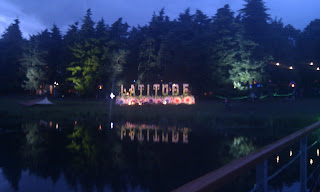
Latitude is a music festival with a difference, also featuring comedy, theatre and literature among much much more. I just got back from this year's festival and thought I'd write about the amazing wordsmithing I found there.
I spent a lot of time in the poetry tent and the poets that I saw read/perform include:
- Sophie Hannah
- Jo Shapcott
- Dizraeli and the Small Gods
- Amy Blakemore
- Hannah Jane Walker
- Kate Fox News
- Jack Dean
- Mab Jones
- Sam Riviere
Who shone? Dizraeli and the Small Gods - a beautiful, emotional mix of music, rap and poetry; Mab Jones - comic, honest poetry about life's minutiae, really loved it; Hannah Jane Walker for thought-provoking, lyrical poems; and Amy Blakemore for a young voice with surprising maturity and real originality. I urge you to check these guys out online, they were fantastic, and I am going to try and persuade a bookshop that I know in Wales to book a reading with Mab Jones!
Who disappointed me? Well, no one really, all the acts I saw were of a really high quality. However, Sophie Hannah's reading was more like a rant and although humourous at times I also left wondering if she was a psychopath..... Sam Riviere's work seemed, from what I caught of it, to be about the issues of identity and being an outsider, including a long poem about a trip to America. Interesting but not my personal cup of tea. Jo Shapcott read a series of poems about bees, and at that point I had to leave. But I was disappointed with her reading - it lacked audience connection, I felt, and although I love her poetry, the beekeeper in me (yes, I do actually keep bees, have done for 6 years now I think) was frustrated with her overly simplistic explanations to the audience about the science behind the poetry, the science of bees, and her mis-pronunciation of the word 'propolis'. But that's just me being nit-pickety.
What really fascinated me however was the different reading/performing styles of the poets. Some read from books or pieces of paper, e.g. Amy Blakemore, Sophie Hannah, Jo Shapcott - whereas others recited their work from memory, e.g. Mab Jones, Dizraeli, Jack Dean. Both methods worked well but undoubtedly those who had memorised their poems gave more energetic performances. So I picked up some interesting tips for when I am brave enough to finally enter an open mic! Who knows, maybe at next year's Latitude...?
Anyway, just a few musings on the world of the live spoken-word performance. For those who are into performance poetry like me, I can highly recommend Latitude festival; the poetry line-up was wide-reaching, varied and inspiring.
Friday, July 8, 2011
Paul Henry Poetry Workshop 1
Wednesday night I went to Bookish in Crickhowell, Wales, and took part in a poetry workshop with poet Paul Henry. It was a great success, a lovely workshop in a cosy atmosphere. A little daunting reading my work out to a bunch of complete strangers! But really improved my confidence in a workshop setting and met some lovely people.
We began with a free-writing exercise, based on the theme of 'where I come from...', before looking at a few poems based around the idea of place, and then attempting to write our own poetry. Everyone in the class came up with some really cool ideas, I was surprised and a little intimidated by the standard, even though half of us had never written anything before! Anyway, I didn't really do as well - it was a great workshop - but I felt that I lacked life & travel experience and distance from my birthplace which may have helped.
The 'poetry' I came up with isn't very good. The workshop made me become more aware of my writing process, through making me try a completely new method. I found writing after - or imitating the first line as a trigger - the poems we looked at (one by R.S Thomas, another by Kit Wright, another that I can't remember right now) challenging and completely new. These are the results so far, but there is nothing I am even slightly happy with yet. However I shall keep trying!
Anyway, this post will show you what I came up with during the workshop and afterwards. I hope it encourages others to come along to the next workshop or to take the plunge and go to a similar writing event. I'd never done anything like this before, and I have never shown my work to anybody in person before, let alone read it out loud, but I loved the experience and can't wait for the next one!
FREEWRITING: WHERE I COME FROM...
er, what shall I write? B_, or B_grad as I call it, kind of grotty but posh in places, or more precisely a little village called O_, a long high street of georgian-fronted houses built along a geological faultline between the clays and chalk & flint, surrounded by fields with its own castle, and of course the sound of the motorway/by-pass always going, cows behind the housing estate mooing in the heat, the swampy ponds in the fields with the fallen oak I used to climb as a kid, oh dear what next can't think of anything, the churchyard with the graves of the two French soldiers, rooks, jackdaws that descend on our garden and eat the animal food, mistletoe growing on oak trees, the river full of crayfish and trout and watermint, the canal where I once saw an otter with her cub,
WORKSHOP ATTEMPTS AT POETRY - came out more like more freewriting
To live in the Home Counties is to
be strung between the motorway and hedgerows
full of fruit as shiny as Next Door's new Audi
that cannot be left outside for fear of pigeon droppings. It is to
To live between two countries is to be always having to choose
Christmas in Wales or in England?
To live in my home town is to... (very scribbled 3rd draft)
be somewhere between the jaguar-driving cricket clubbers, ex-military, busy-bodied, feeding the charity shop with last week's trends: a gucci handbag, real italian leather, a laura ashley dress, a striped armani shirt - and the one's down B_ Road, where the drugs and murderers are. It is to revel in gossip, the GP dating the shopkeeper's estranged wife who had an affair with so-and-so, the scandal of the hint of the possibility of encroaching supermarkets versus the convenience of waitrose ready meals and the battle of the georgian-fronted high street and the affordable housing estates at christmas: tasteful blue lights, holly wreaths, versus houses bedecked with americana
POST WORKSHOP DRAFTING
Tiptoe over conifer needle-strewn tarmac for fear of dog shit, its orangey iron-smell sharp, making your nostrils flare. As you walk brambles claw their way over the tops of the fence, snagging your hair and clothes. Burs coat the hem of your sleeve. A snail's shell cracks underfoot. A blackbird cackles in fear, swooping in front of you like a dolphin before a ship.
The path is dark. Dank. Damp. Houses rise unfriendly behind the fences on either side. Blank windows. Net curtains. Peeking out from behind the conifer trees. The path is rising, inclined to the breast that continues, it seems, ito the grey ink of the sky. Stones, gravel, punching through the soles of your shoes.
Until you emerge, blinking, blinded and shocked by the view. A field of blue-green wheat stretching to a hedgerow horizon. Oast roofs in red and mossy tiles poke like upturned strawberries from amongst the greenery. Unseen cricket drums a lazy rhythm. The air tastes of poppies and mallows, watermint from the river, hobby farm sheep, oak trees.
You feel that you can breathe it in, this openness, the wheat
the egg-brown earth, its chalk, its flint, is unyielding beneath your feet.
DRAFT 3
dog shit, orangey iron-smell sharp, makes nostrils flare.
brambles clawing over top of fence, snag hair.
burs broider hem of sleeve. snail's shell cracks underfoot
blackbird cackles in fear, swoop
in front like dolphin before ship. Path. Damp. Narrow.
Houses unfriendly, fences: empty windows.
Net curtains. Peek.
path, inclined to grey sky ink.
emerge, blinking, shocked by view
field of blue
wheat stretches to hedgerow horizon. Oast roofs, red mossy
tiles, upturned strawberries amonst greenery.
Unseen cricket drums lazy
rhythm. air taste poppies, mallows, hobby farm sheep, oak trees
breathe it in, openness, wheat
egg-brown earth, chalk, flint, unyielding beneath my feet.
Subscribe to:
Posts (Atom)